Fuse Boards & Consumer Units
Fuse Board Upgrade: Do You Actually Need One?
Most Irish homes sit on one of four generations of fuse board, and the test button on the front tells you which one you have. That single detail decides the answer: whether yours needs replacing, whether it only needs one circuit traced, or whether it is fine as it stands and the money is better spent elsewhere.
Registered with Safe Electric · Certified to I.S. 10101 · Test-button guidance per HSA
Start Here
Go and look at the board before you do anything else
When a fuse board keeps tripping, four things can have happened and they mean four different things. Two minutes at the board is the difference between a call-out that finds the fault immediately and one that starts from zero.
One MCB: a single small switch
Overload or a short circuit on that one circuitAn MCB protects one circuit against too much current. It has gone because that circuit drew more than it is rated for, or because live touched neutral somewhere. If it resets and holds, you probably overloaded it. Too much on one ring will do it. If it goes again the moment you reset it, something on that circuit is faulty and needs finding. Resetting it over and over will not help.
The RCD: a wider switch with a test button
Earth leakage somewhere on the circuits it coversAn RCD compares the current going out on live with the current coming back on neutral. If they do not match, current is escaping somewhere it should not: through damaged insulation, through water, or through a person. It disconnects in milliseconds. One RCD usually covers several circuits, so the fault could be on any of them, and a single failing appliance can put the whole house in darkness.
An RCBO: one switch, one circuit, with a test button
Either fault, but confined to that circuitAn RCBO is an MCB and an RCD in a single device, fitted per circuit. The advantage is isolation. A fault on the kitchen takes out the kitchen and nothing else. If your board is all RCBOs and one has tripped, you already know which circuit to investigate.
The main switch, or nothing at all
Look outside before you look insideIf nothing in the board has tripped and there is no power, the problem is most likely on the supply side rather than yours. Check whether the neighbours have power. A network fault is ESB Networks' job on 1800 372 999, free and 24 hours. An electrician cannot legally work on the supply side of your meter.
Do it interactively. Our fault finder walks the same logic question by question and narrows it to a circuit. Free, no contact details needed to see the result. For a broader read on the installation, the electrical health check takes two minutes.
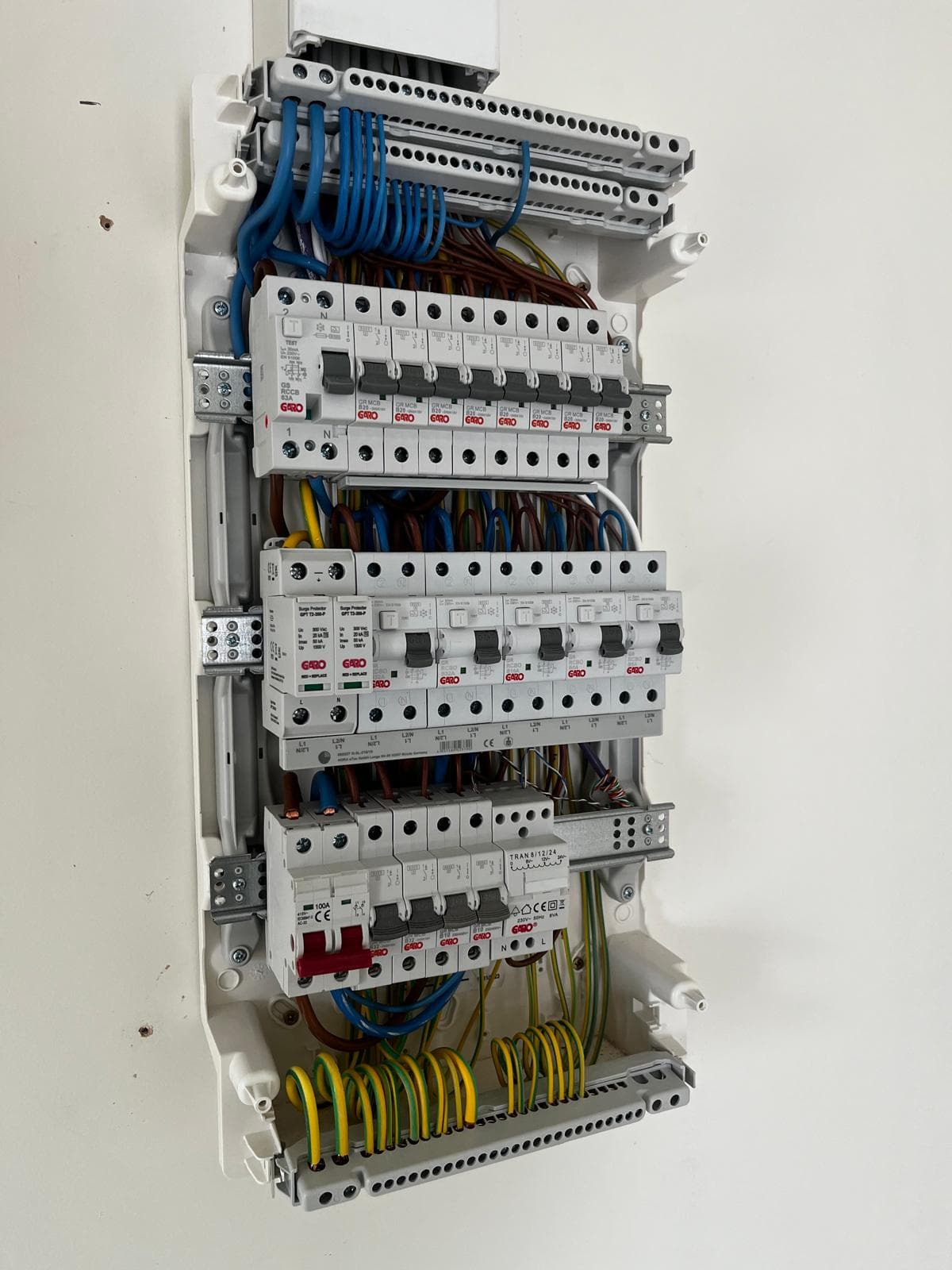
A board with per-circuit RCBOs. A fault isolates to one room instead of the whole house.
Read Your Board
Four generations, and the test button tells you which you have
Boards get changed and houses do not get younger, so the age of the house is a weaker guide than the board itself. One glance for a test button places you immediately.
Rewireable fuse carriers
What it looks like · Ceramic or bakelite carriers you pull out. Fuse wire inside. No test button anywhere on the board.
Two issues here, and neither is cosmetic. The first is that there is no earth-leakage protection at all. Nothing on the board is watching for current escaping to earth, and that is the fault that causes electric shock rather than the one that damages appliances. The second is that a fuse carrier can be rewired with whatever wire is to hand, so the protection is only as good as the last person who fixed it in the dark. A board like this is not automatically dangerous. It is missing a category of protection that later boards have.
Common in housing stock from the earliest bands. See our pre-1960s page
MCBs, no RCD
What it looks like · Small switches you flick back up. Still no test button.
A real improvement on fuse wire, because the protection is consistent and cannot be re-wired wrongly. It is still overcurrent protection only. It protects the cable from overheating. It does not protect a person from a shock. This is the board that surprises people most often, because it looks modern enough that nobody questions it.
Very common in mid-band stock
MCBs plus one or two RCDs
What it looks like · Small switches, plus one or two wider devices carrying a T or TEST button.
Earth-leakage protection is present, which is the important part. The weakness is grouping. One RCD covering eight circuits means a fault on any one of them takes out all eight. A failing immersion or a wet outdoor socket can put an entire floor of the house in darkness, and fault-finding on this arrangement takes longer.
Typical of the Celtic Tiger band and after
RCBO per circuit
What it looks like · A row of near-identical devices, each with its own test button.
Not a problem. This is the arrangement worth having. Each circuit gets both overcurrent and earth-leakage protection independently, so a fault isolates to the room it happened in. The benefit shows up in ordinary ways. Your freezer stays on when the shower develops a fault.
What a board change specified to the current standard normally looks like
Note what this section deliberately does not say. We have not given you a year when any of this became a requirement, because every source we could find for Irish RCD and cable-colour dates traced back to British regulations rather than Irish ones. Rather than repeat something we cannot stand over, we describe what is in front of you. If you want the current standard itself, it is I.S. 10101, published by the NSAI.
The Sneaky One
When it trips at random and nothing is broken
This is the fault that wastes the most money, because people keep calling out electricians who find nothing wrong. Every appliance leaks a tiny amount of current to earth as a normal part of how it works. Anything with a heating element, a motor or a mains filter does it: a washing machine, an immersion, an oven, a dishwasher, a PC power supply. Individually each one is well inside tolerance and completely harmless.
Add them together across a whole house on a single RCD and the standing leakage can sit just below the level at which the device disconnects. The board holds fine for days. Then one more thing switches on, the immersion or the tumble dryer on a damp morning, and the total tips over the line. Everything goes off. You reset it, it holds again, and nothing appears to be wrong, because in the ordinary sense nothing is.
It cannot be guessed at. Finding it means measuring the standing leakage circuit by circuit with an instrument, which identifies which appliances are contributing most and whether any one of them has drifted beyond normal. Sometimes the answer is a failing appliance. More often the answer is that too many circuits share one RCD, and splitting them across per-circuit RCBOs solves a problem that no amount of appliance-swapping would have fixed.
Worth knowing before you call anyone: if you can tell us it happens when a specific appliance runs, or only in wet weather, or only in the evening, you have already done most of the diagnostic work. A random trip and a patterned trip are different investigations.
The Correction
A new board does not fix bad wiring. It just protects you from it better
The consumer unit is the part of the installation you can see, so it takes the blame for problems that live behind the plaster. It is worth being clear about what a board change is: a box of protective devices, replaced. It does not repair a damaged cable, a wet outdoor socket, deteriorating insulation or a failing appliance. Those are all still there afterwards.
What changes is that faults become visible and contained. Per-circuit RCBOs isolate a fault to the room it happened in, so instead of the house going dark you get a single circuit off and an obvious place to look. And a board change involves testing every circuit, which is frequently the moment a long-standing problem finally gets identified. Both of those are worth having. Neither of them is a repair.
The honest version is that sometimes a board change is the whole job, and sometimes it is the cheap part of a bigger one. Which of those you are looking at is decided by the insulation resistance test on the existing circuits, not by the age of the house and not by how old the board looks. So we test before quoting one. A price given over the phone without testing is a guess.
When It Is Justified
Six reasons a board change earns its money
And the corollary: if none of these apply to you, a working board that is not tripping does not need replacing because someone told you it looked old.
No earth-leakage protection anywhere on the board
The strongest reason on this list. If nothing on your board has a test button, nothing is watching for the fault that causes electric shock. That is a missing protection category rather than a compliance box, and it is the one gap on an older board worth acting on.
Adding an EV charger
A charger needs its own protected circuit. An older board may have no spare way, no suitable protection, or a main switch that is not rated for the extra load. This is the most common reason an EV install costs more than the quoted headline, and it is better established before you order the charger.
An extension, attic conversion or garden room
New circuits need somewhere to land. If the board is full, the honest options are a change or a sub-board, and which one is cheaper depends on where the new load sits relative to the existing one.
Signs of heat: discolouration, a smell, a warm faceplate
Browning around a device, a faint burning smell near the board, or anything warm to the touch means a connection is running hotter than it should. That one does not keep.
It trips and nobody has found out why
Repeated resetting defers the problem instead of solving it. Something is causing the trip, and the protective device is doing precisely the job it exists to do. Find the cause first. The board may not even be the answer.
A Periodic Inspection Report has coded items 1 or 2
Those are the codes that mean urgent attention or improvement required. A code 4, meaning the installation does not comply with the current rules, is a different thing. On an older installation a code 4 is common and often not a safety issue at all.
Cost
What it costs is a separate question, and we answer it properly elsewhere
This page is about whether you need one and why it is tripping. Price deserves its own treatment. A straight swap and a job that uncovers earthing work are different numbers, and explaining what moves between them takes more room than a sentence here would give it.
Fuse board upgrade cost in Ireland, 2026
Real ranges, what pushes a job from a swap into remedial work, and why earthing and main bonding so often come up at the same time.
And we’re set up to act on it. J Cowman Electrical Contractors has been Safe Electric registered since 2021 under registration A6700, carries public liability cover up to €6.5M, and runs a 10-strong crew across Wexford, Dublin and the rest of Leinster. Every job is certified to IS 10101 and the completion certificate is handed over on the day the work finishes, whether that job is a board change or a full rewire.
FAQ
Fuse Boards: Common Questions
My board keeps tripping. Does that mean I need a new one?
Usually not. A board that trips is the one part of the system doing exactly what it was fitted to do, and swapping it does not fix whatever made it go. Establish which device went first. A single MCB means overload or a short on that one circuit: too much plugged into one ring, or live touching neutral somewhere. An RCD means current is leaking to earth on the circuits it covers, and that is the more serious category, because it is the fault that can put current through a person. If nothing on the board has tripped at all and the power is off, the problem is probably on the supply side and belongs to ESB Networks on 1800 372 999 rather than to an electrician. The board itself only becomes the answer when the board is what is causing the disruption: grouped RCDs that take out half the house for one appliance fault, or a generation with no earth-leakage protection at all. Work through our fault finder first. Narrowing it to a circuit takes a couple of minutes and it means we arrive knowing what we are dealing with.
It trips at random with nothing obviously wrong. What causes that?
Almost always cumulative earth leakage, and it is the hardest fault for a homeowner to reason about. Every appliance leaks a tiny amount of current to earth by design: a washing machine, an immersion, an oven, anything with a heating element or a filter. Individually each one is harmless and well within tolerance. Added together across a house, they can sit just under the trip threshold, so the board holds most of the time and then goes when one more thing switches on. Nothing is broken in the way people expect broken to look. Finding it means measuring the standing leakage circuit by circuit rather than guessing, and it is one of the clearest arguments for splitting circuits across RCBOs instead of grouping them on one RCD.
How do I know which generation my board is?
Look for a test button. If there is no button anywhere on the board, you have overcurrent protection only: either fuse wire in pull-out carriers, or MCBs if the devices are small switches you flick back up. If there are one or two wider devices with a T or TEST button, you have grouped RCD protection. If nearly every device has its own test button, you have RCBOs and each circuit is independently protected. That one observation tells you more about your installation than the age of the house does, because boards get changed and houses do not get younger.
Will a new board fix my tripping?
Only if the board is the problem, and often it is not. A consumer unit is a box of protective devices. Changing it gives you better and more granular protection, but it does not repair a damaged cable, a wet outdoor socket or a failing appliance. What frequently happens is that a new board with per-circuit RCBOs makes an existing fault far easier to locate, because the trip isolates to one circuit instead of taking out half the house. That is useful, but it is diagnosis rather than repair. We test before quoting a board change for that reason. It is the only way to tell you honestly whether the board solves your problem or merely reveals it.
Is a board with no RCD illegal?
No, and it is worth being precise here because a lot of the advice written for Irish homeowners was copied from UK sources. An installation built to the standards of its day is not retrospectively unlawful because the standards moved on. Safe Electric states plainly that a non-compliance with the current National Rules does not necessarily mean an installation is unsafe. What is true is that a board with no earth-leakage protection lacks a category of protection that modern boards have, and that gap is a real safety consideration rather than a paperwork one. Those are different arguments and you deserve to hear the accurate one.
Should I press the test button myself?
Yes, and the Health and Safety Authority's guidance recommends doing it at least twice a year independently of any inspection regime. Press the button on each RCD or RCBO. It should trip immediately and cut power to whatever it protects. Reset it afterwards. If it does not trip when tested, the device that is meant to protect you is not working, and that is worth a call rather than a note in the diary. Do the test at a time when losing power for a moment is not a problem, and check anything with a clock or a freezer afterwards.
How long does a board change take?
A straightforward change is usually a half-day to a full day on site, and the power is off for most of it. The variable is not the board itself. It is what has to happen around it. Earthing and main bonding often need bringing up to the current standard at the same time, and every circuit has to be tested and certified before the job is finished. Where the existing wiring turns out to have faults, those surface during testing rather than after, which is the point of testing. You get a Safe Electric Completion Certificate on the day the work finishes.
Do I get a certificate for a board change?
Yes, and it is a legal requirement rather than a courtesy. The Electricity Regulation Act 1999, as amended, makes it mandatory for a Registered Electrical Contractor to issue a Completion Certificate for all electrical works other than minor works. Keep it: a buyer's solicitor will ask for it, and so will the next electrician who works on the house. If you have had a board changed and never received a certificate, something went wrong, because only a registered contractor can issue a valid one.
My board is full. Do I need a new one to add a circuit?
Not always. Where there is no spare way, the two options are a board change or a separate sub-board fed from the existing one, and which is cheaper depends on where the new load sits. A garden room or a garage at the far end of a site often makes more sense on its own sub-board than on a longer run back to a replaced main board. If the existing board is already an older generation with no earth-leakage protection, the calculation usually tips towards changing it, because you are getting a protection upgrade rather than just a place to land a cable.
What does the board have to do with rewiring?
They are separate jobs that often get discussed together, and conflating them costs people money in both directions. A board change replaces the protective devices. A rewire replaces the cable. A house can have sound wiring and an obsolete board, in which case a board change is the whole job. It can equally have a modern board bolted onto deteriorating cable, which is the worse situation and the one testing exists to find. Which you need is decided by what the insulation resistance test says, not by the age of the house or the look of the board.
Related
Where to go next
Tripping right now?
Send us a photo of the board with the tripped device showing, and say what was running when it went. That is usually enough for us to tell you whether it is urgent before we arrive.
Written and checked by
Jamie Cowman, Registered Electrical Contractor
Jamie runs J Cowman Electrical Contractors and holds Safe Electric registration A6700, which is what allows a Completion Certificate to be issued on this kind of work. Everything on this page reflects how the job is actually priced and sequenced on site, not a generic specification.
From a Single Rewire to Full Developments: Send Us the Details.
Send us your plans or a quick description. We return a fixed-price quote within 48 hours, no obligation, no sales calls.