Testing & Certification
Most of What You’ve Read About Irish Electrical Certs Was Written for the UK.
Ireland does not use EICRs. Irish landlords are not on a five-year certificate cycle. You do not need a cert to sell your house, but you do need one for work that was carried out, and that one is a legal requirement. Here is what actually applies, with the source for each.
Sourced from Safe Electric, the Health and Safety Authority and S.I. 137/2019 · Registered contractor A6700
The Corrections
Six things people are told, and what is actually true here
None of these are obscure. They are the six statements we hear most often, and nearly every one traces back to British regulations being quoted at Irish homeowners. Two of them cost people money in opposite directions.
“You need an EICR.”
There is no such document in the Irish system. An EICR, or Electrical Installation Condition Report, is the British document issued under BS 7671. The Irish equivalent is a Periodic Inspection Report, a PIR, issued on numbered forms by a Registered Electrical Contractor. Ask for an EICR in Ireland and you will get a PIR, which is the right document. It is worth knowing the name, because most of the advice you will find online was written for a different country.
“The report grades faults C1, C2 and C3.”
That is the UK coding. An Irish PIR uses a numbered system from 1 to 4: 1 requires urgent attention, 2 requires improvement, 3 requires some attention, and 4 means the installation does not comply with the current National Rules. The distinction matters most at code 4, because Safe Electric states plainly that a non-compliance with the current rules does not necessarily mean the installation is unsafe. Wiring installed correctly under an older edition of the rules is not automatically dangerous. It is simply not what would be installed today.
“Landlords must have a cert every five years.”
Not in Ireland. That five-year duty is English law, introduced for the private rented sector in England in 2020. The Irish obligation sits in the Housing (Standards for Rented Houses) Regulations 2019, and what it requires is that electricity supplies are safe and in good repair. No certificate is specified, no interval is specified, and enforcement is by local authority inspection with an Improvement Notice or a Prohibition Notice rather than by a document check. A landlord still carries a real duty, but it is a duty about the condition of the installation rather than about holding a piece of paper.
“I can’t sell the house without an electrical cert.”
No Irish law requires an electrical certificate in order to sell a property, unlike the BER, which genuinely is required for a sale or a letting. What conveyancing does ask for is the Completion Certificate for electrical work that was actually carried out: a rewire, an extension, a board change. If work was done and the certificate cannot be found, that is what stalls the sale. The absence of a periodic report does not.
“A PIR is a certificate.”
It is explicitly not. Safe Electric's own guidance says a Periodic Inspection Report is a report and not a Completion Certificate. A PIR describes the condition of an installation, good or bad. A Completion Certificate certifies that work carried out meets the national wiring rules. They answer different questions and one cannot be substituted for the other, which is why asking the person who requested it what they actually need is worth doing before booking anything.
“There’s no legal certificate requirement in Ireland at all.”
This is the opposite error and it is the one that costs people money. The Electricity Regulation Act 1999, as amended, makes it mandatory for a Registered Electrical Contractor to issue a Completion Certificate for all electrical works other than minor works, and minor works must be certified if the customer asks. If you have had work done and never received a certificate, something has gone wrong, and only a registered contractor can issue a valid one.
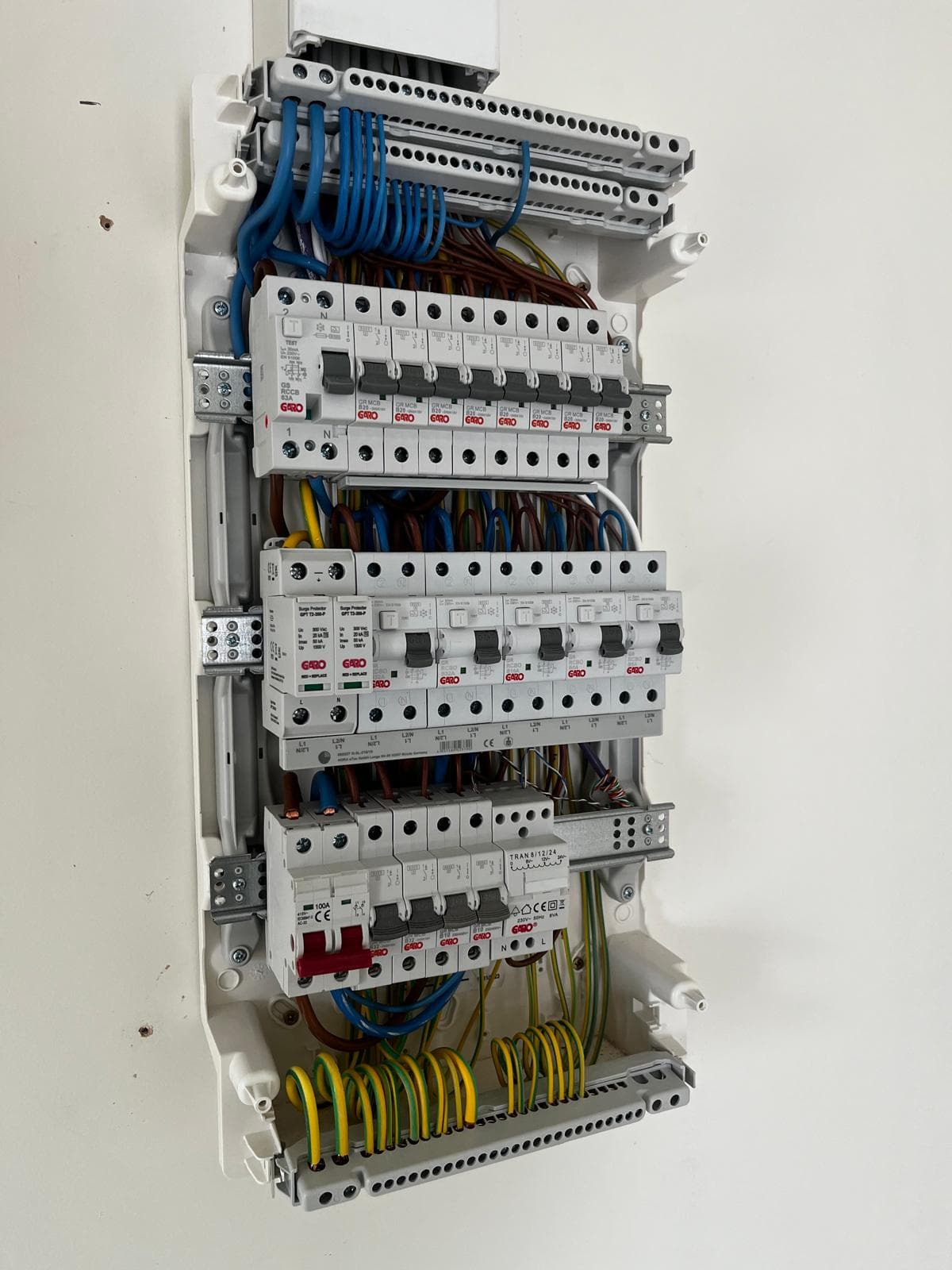
Periodic Inspection Report and Test Record Sheet: measured values, not a one-line pass.
Who Has A Duty
The Irish rule is the inverse of what most people assume
People expect a periodic testing obligation on homes, and are surprised that certification of work is where the law is strictest. It is worth knowing which of these four you fall into, because the answer changes completely.
Employers and business premises
A genuine statutory dutyRegulation 89 of the Safety, Health and Welfare at Work (General Application) Regulations 2007 requires an employer to ensure an existing electrical installation is tested by a competent person from time to time, having regard to the nature, location and use of the installation, that defects found are rectified promptly, and that a report of the test is completed. No interval is written into the law, since it is supposed to come out of a risk assessment, but the duty itself is not optional.
Commercial intervals and certificationLandlords
A condition duty, not a certificate dutyThe 2019 rented-house standards require that electricity supplies are safe and in good repair. There is no prescribed certificate and no prescribed interval. In practice a current PIR is the most straightforward way to evidence that you met the duty if it is ever questioned, and most agents and insurers now ask for one. That is a commercial expectation rather than a statutory requirement, and it is worth knowing which is which.
Homeowners
No periodic duty at allNothing in Irish law obliges you to have your own home tested on any schedule. What does apply is the certification duty on work carried out: if you have anything other than minor works done, the contractor must issue a Completion Certificate. Keep it. The next buyer's solicitor will ask for it, and so will the next electrician who works on the house.
Fuel storage premises
Fixed statutory intervalsThe one place Irish law does set hard deadlines. Regulations under the Dangerous Substances Act 1972 require inspection and testing of retail and private petroleum stores at least every three years, petroleum bulk stores at least every twelve months, and oil jetties at least every fifteen months.
When It Is Worth Doing
No legal duty is not the same as no good reason
Having established that most people are not obliged to do this, here is the honest case for doing it anyway. The triggers that matter are events, not dates.
Buying an older property
The cheapest survey you will ever buy. An older house with original wiring can need anything from a board upgrade to a full rewire, and knowing which before you sign changes the number you offer. A report that flags remedial work is a negotiating position, not a reason to walk away.
Taking on a property to let
Establishes the condition at the start of the tenancy and gives you evidence you met the standards duty. Doing it before a tenant moves in is straightforward; doing it after a fault is not.
Nobody can find the paperwork
If work was done and the Completion Certificate has been lost, a PIR does not replace it, but it does document the current condition, which is usually what the solicitor is actually trying to establish.
After a flood, a fire or water ingress
Water and heat damage cable and accessories in ways that are not visible from the outside. This is one of the few situations where an inspection is genuinely urgent rather than prudent.
Before spending money on a board change
Changing the consumer unit does not fix what is behind it. Testing first tells you whether a new board solves your problem or simply protects you better from a problem that is still there.
An installation over about 25 years old and untouched
Not a rule, and not a deadline. An installation of that age has usually outlived at least one edition of the wiring rules and is worth a look. What the report finds decides whether anything needs doing.
Not sure whether it is urgent? Our free electrical health check asks plain-English questions about your board, your lights and your circuits and gives a colour-coded read on whether an inspection needs doing now or can wait. No contact details required to see the result. If something is actively tripping, the fault finder will narrow it down first.
The Tests
What a proper inspection actually measures
A visual walk-round is not an inspection. These are the tests set out in the national rules, and the report you receive should carry the measured value for each rather than a tick.
| Test | What it tells you |
|---|---|
| Continuity of protective conductors and bonding | Confirms the earth path is actually continuous back to the board. This is the most important test on the list. An installation with a broken earth can look and behave completely normally right up until the moment it matters. |
| Continuity of conductors in ring final circuits | A ring circuit broken at some point, often by an addition made years earlier, behaves like a long radial and can be overloaded without anything tripping. |
| Insulation resistance | Measures whether the insulation around the conductors is still doing its job. This is the test that finds age-related deterioration in older cable before it becomes a fault. |
| Polarity | Confirms live and neutral are the right way round throughout, including at every accessory. Reversed polarity leaves parts of an appliance live even when it is switched off. |
| Earth fault loop impedance | Determines whether the protective device will actually disconnect fast enough in a fault. A circuit can be wired correctly and still fail this if the loop impedance is too high. |
| RCD operation and tripping times | Verifies that the residual current device trips, and trips quickly enough to prevent a fatal shock rather than merely at some point. |
What you receive at the end
The original Periodic Inspection Report and the completed Test Record Sheet, with any defects listed and a recommendation coded against each on the 1–4 scale. Where a serious defect is found, including one outside the scope of what we were called for, a Notice of Potential Hazard is issued alongside it. Records for a permanent installation should be kept for at least ten years and handed to whoever inspects it next: a previous set of readings is the only way to tell what has changed.
Cost
What an inspection costs
We publish real ranges rather than hiding behind “contact us for a quote”, but they are a guide, not a quote. A Periodic Inspection Report on a typical three-bed house takes two to three hours and runs around €200–€350, depending on the size of the property and how many circuits there are to test. A larger house, a property with outbuildings, or an installation with no existing documentation takes longer and costs more.
The single biggest reason two inspection quotes differ is scope. A price at the very low end is often a visual check with a document attached rather than a full test with measured values, and the two are not the same product. Ask what instruments are used and whether you get the Test Record Sheet with actual readings on it. That question separates the two immediately.
If the report flags remedial work we price it separately and clearly, and there is no obligation to have us carry it out.
The figure above is an indicative range for guidance only. It is not a quote and not an offer. Inspection cost varies with property size, circuit count, access, the condition of the existing installation and whether any documentation exists for it, none of which can be judged from a photograph or a phone call. You get an accurate fixed price in writing once we know what we are inspecting.
And we’re set up to act on it. J Cowman Electrical Contractors has been Safe Electric registered since 2021 under registration A6700, carries public liability cover up to €6.5M, and runs a 10-strong crew across Wexford, Dublin and the rest of Leinster. Every job is certified to IS 10101 and the completion certificate is handed over on the day the work finishes, whether that job is a board change or a full rewire.
FAQ
Testing & Certification: Common Questions
Is it an EICR or a PIR in Ireland?
A PIR, or Periodic Inspection Report. EICR is the British term, used under BS 7671, and it appears in a lot of advice aimed at Irish readers simply because that advice was written for the UK. If your solicitor, agent or insurer asks for an EICR, a Periodic Inspection Report from a Safe Electric registered contractor is the Irish document they need.
Do Irish landlords legally need an electrical certificate?
No. The Housing (Standards for Rented Houses) Regulations 2019 require that electricity supplies are safe and in good repair, and enforcement is by local authority inspection rather than by producing a document. There is no statutory certificate and no statutory interval. The five-year rule people quote is English law and does not apply here. That said, a current Periodic Inspection Report is the most practical way to evidence that you met the condition duty, and many agents and insurers now expect one.
Do I need an electrical cert to sell my house?
Not by law. The document required by law on a sale is the BER. What a buyer's solicitor will ask for is the Completion Certificate covering any electrical work that was carried out on the property: a rewire, a board change, an extension. If that work was done and the certificate is missing, that is what causes the delay.
What does the numbering on a Periodic Inspection Report mean?
Irish PIRs use a scale of 1 to 4. Code 1 requires urgent attention, code 2 requires improvement, code 3 requires some attention, and code 4 means the installation does not comply with the current National Rules for Electrical Installations. Safe Electric states explicitly that a code 4 does not necessarily mean the installation is unsafe. Wiring installed properly under an earlier edition of the rules is often perfectly safe; it is simply not what would be installed today. We go through every code on your report in plain English so you know which items are safety issues and which are simply age.
How often should a home be tested?
Irish law sets no interval for a private home, and we are not going to invent one. The national rules say frequency is determined by the type of installation, its use, how well it is maintained and the conditions it is subjected to. In practice the triggers that matter are events rather than dates: buying, letting, water damage, an installation that has never been looked at, or a board change being considered.
What is a Notice of Potential Hazard?
A specific Safe Electric form issued when a registered contractor identifies a serious defect or a potential hazard, including one that has nothing to do with the job they were called out for. If we find something dangerous while doing unrelated work, we are obliged to tell you about it in writing. It is not a sales tactic; it is a duty of care with a form attached.
What do I get at the end?
The original Periodic Inspection Report and the completed Test Record Sheet, with the measured values rather than a one-line pass. Any defects are listed with a recommendation against each. Hold onto it. Records for a permanent installation should be kept for at least ten years and given to whoever inspects it next, because a previous set of readings is genuinely useful for spotting what has changed.
Do I have to use you for any remedial work you find?
No, and you should not feel any obligation to. The report is the report. If it flags work, we price it separately and clearly, and you are free to take that price anywhere. A contractor who will only give you the report on condition of doing the work is not giving you an independent assessment.
Is there anything I can check myself?
Yes, and it is free. The HSA's guidance recommends pressing the test button on your RCD at least twice a year, independently of any other inspection regime. It should trip immediately and cut the power. A visual once-over for cracked faceplates, scorch marks, loose fittings and anything warm to the touch is also worth doing and does not require an electrician. If the RCD does not trip when tested, that is worth a call.
Related
Where to go next
Been asked for a cert and not sure which one?
Forward us the request from your solicitor, agent or insurer and we will tell you which Irish document it maps to, including if the honest answer is that you do not need one.
From a Single Rewire to Full Developments: Send Us the Details.
Send us your plans or a quick description. We return a fixed-price quote within 48 hours, no obligation, no sales calls.