New Build Electrical
Wiring a New Build House in Ireland
Whether you’re building one house on your own site or delivering ninety of them, the standard is the same: first fix to final cert, certified unit by unit. What changes is the conversation.
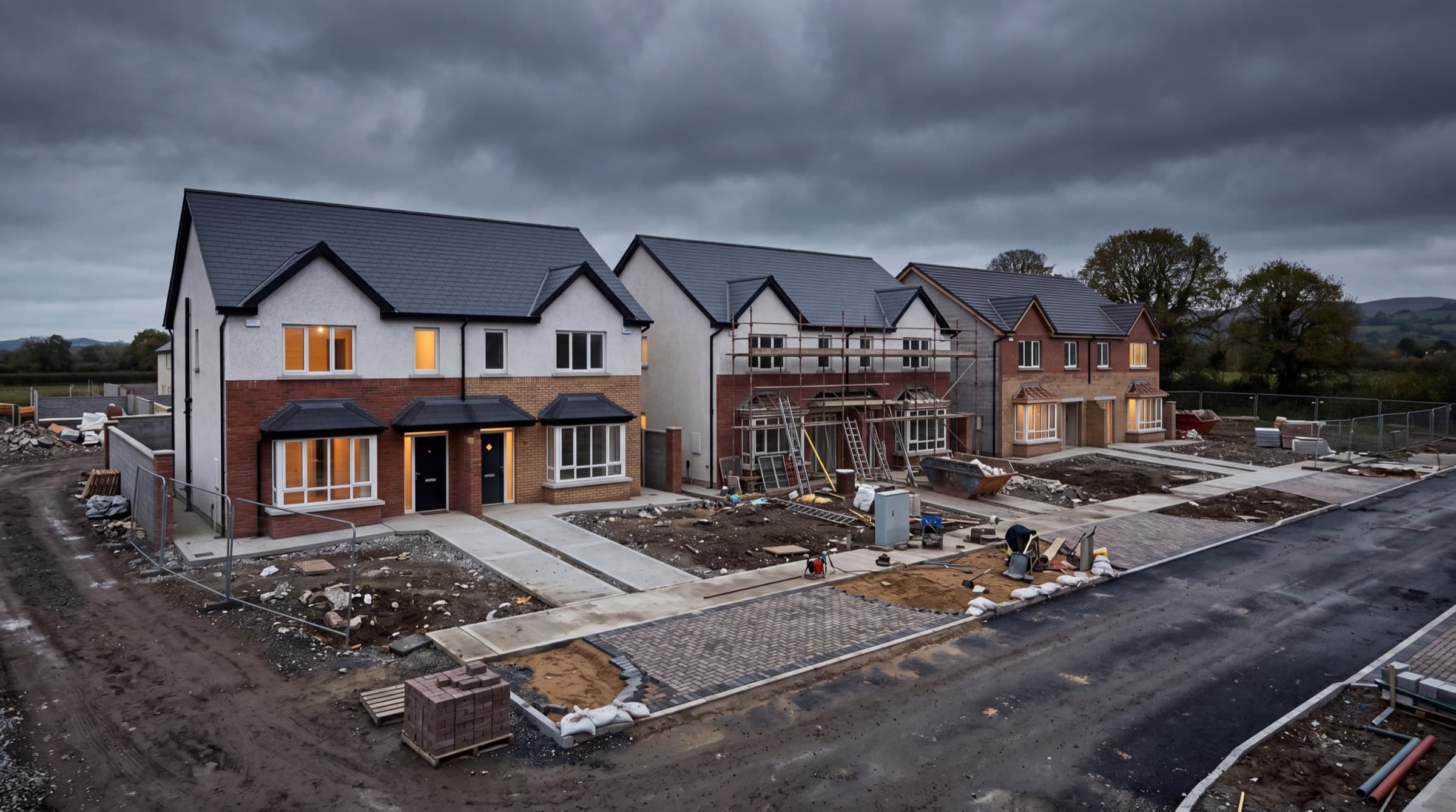
First fix to final cert. One-off houses and multi-unit developments.
Start Here
Two very different jobs
Most new-build electrical pages are written for developers and leave self-builders to work out which bits apply to them. These are not the same job. One person is spending their own money and making every spec decision themselves; the other needs a crew that hits a programme across dozens of units without supervision. Both are welcome here. Find yours.
Building your own house
You own the site. You’re making the decisions, probably for the first and only time, and you want to understand the options rather than be handed a schedule.
Self buildDevelopers & main contractors
You need capacity, programme discipline and certification that closes out cleanly across every unit. The question is whether we’ve done it at your scale.
Development workSelf Build
Building your own house
One-off houses are a bigger part of the market than people assume, and outside the commuter belt they dominate it. Wexford alone saw 979 single houses completed between 2023–2025, the highest one-off count of any county we work in.
If you’re building your own, the most useful thing on this page is the first line below: bring an electrician in at design stage. Not before plasterboard, but at design stage, while the drawings can still change for free.
Design stage, before the foundations
The cheapest hour anyone spends on a new build's electrics, and the one most often skipped. Deciding socket positions, lighting circuits, data runs, where the board goes and whether there's an EV way in it costs nothing on a drawing. Once the blocks are up and the plumber has taken the obvious routes, the same decisions cost real money.
First fix, before plasterboard
Cable, back boxes and fixed wiring go in while the studs and blockwork are open. This is where the spec becomes physical: every socket, switch, light point, data outlet and appliance circuit gets its cable pulled. Changing your mind after this is a chase-and-repair job, not an electrical one.
Second fix, after plaster and decoration
Sockets, switches, light fittings and the board itself go on. We schedule this after the plasterer and painter rather than before, because fittings installed ahead of decoration get damaged and then get argued about.
Testing and certification
Every circuit tested and recorded, the completion certificate filed under registration A6700. ESB Networks will not energise a new supply without certification, so this sits on the critical path to getting the house live rather than at the end of a snag list.
What to actually decide at design stage
“Decide your spec early” is useless advice without a list. This is the one we work through with self-builders, and the honest framing is that almost every item is cheap now and expensive later, not because of the fitting, but because of the wall it has to go through once the house is finished.
Sockets per room, and be more generous than feels sensible
The commonest regret on a finished self build, by a distance. Four doubles in a bedroom sounds excessive on a drawing and looks about right once a bed, two lamps, two phone chargers and a laptop are in the room. Kitchens and home offices need more again. Adding sockets at first fix is cable and a back box; adding them afterwards is chasing a finished wall.
Where the board goes, and how many spare ways it has
Somewhere accessible, not behind a fitted wardrobe or at the back of a hot press. Spare ways matter more than people expect. Every future addition (EV, hot tub, garden office, solar) needs one, and a board with none means a second board later.
Data cabling, decided now or not at all
Wi-fi does not solve everything, and a cabled point to the office, the TV position and any wall-mounted access point is worth having. This is the item most often skipped and most often regretted, because retrofitting cable through a finished airtight house is genuinely awkward.
Lighting layout, circuit by circuit
Which lights switch together, what gets dimmed, whether there are two-way switches at the top and bottom of the stairs and both ends of a long hall. Cheap to decide, tedious to change. Think about where you will actually stand when you want the light on.
Outdoor: sockets, lighting and the shed
An external socket front and back, lighting to the door and the drive, and a supply to a shed or garage if there might ever be one. Running a duct to the end of the garden while the site is still open ground costs very little; digging up a finished driveway does not.
EV, beyond the legal minimum
The regulations require the infrastructure, not the charger. Putting in a proper EV way in the board and cable to the parking position at first fix costs a fraction of retrofitting it, and it is the difference between a charger being a morning's work later or a small project.
The smart home configurator will take you through the automation and data side room by room if you want a written spec to hand an electrician.
Your heating strategy is an electrical decision now
This is the biggest difference between wiring a new house and wiring an old one, and it catches people who are comparing a new-build quote against what a rewire cost their neighbour. New dwellings fall under the NZEB requirements in Part L of the Building Regulations, which in practice means the house is designed around a heat pump and a renewables contribution rather than a boiler.
Electrically, that changes the sums. A heat pump is a significant, sustained load that has to be designed for from the start rather than added to a board later, and it usually sits alongside solar PV, a hot-water cylinder with an immersion, mechanical ventilation, and increasingly an EV on the drive. Each of those is its own circuit and its own load calculation. Get the heating and hot-water strategy settled before the electrical design is finalised, because changing from an oil boiler to a heat pump after first fix means redoing more than the plumbing.
The practical consequence for a self-builder: whoever is designing your electrics needs to know your BER target and your heating spec, not just your room layout. If an electrician quotes a new build without asking about either, that is worth noticing.
The thing self-builders forget to budget for
The ESB Networks connection is a separate cost, paid directly to ESB Networks rather than to your electrician, and quoted per site based on distance to the nearest network and whether the run is overhead or underground. People price the wiring carefully and get caught by the connection.
Apply early. It carries a lead time, and the house cannot be energised without it. What we handle is everything from the meter inwards, plus the certification ESB Networks need before they will switch you on.
Counties where one-off building is the norm rather than the exception, by share of all completions 2023–2025: Longford 56% · Carlow 34.6% · Offaly 33.4% · Wexford 31.7% · Kilkenny 27.6% · Westmeath 24.1% · Waterford 20.4%.
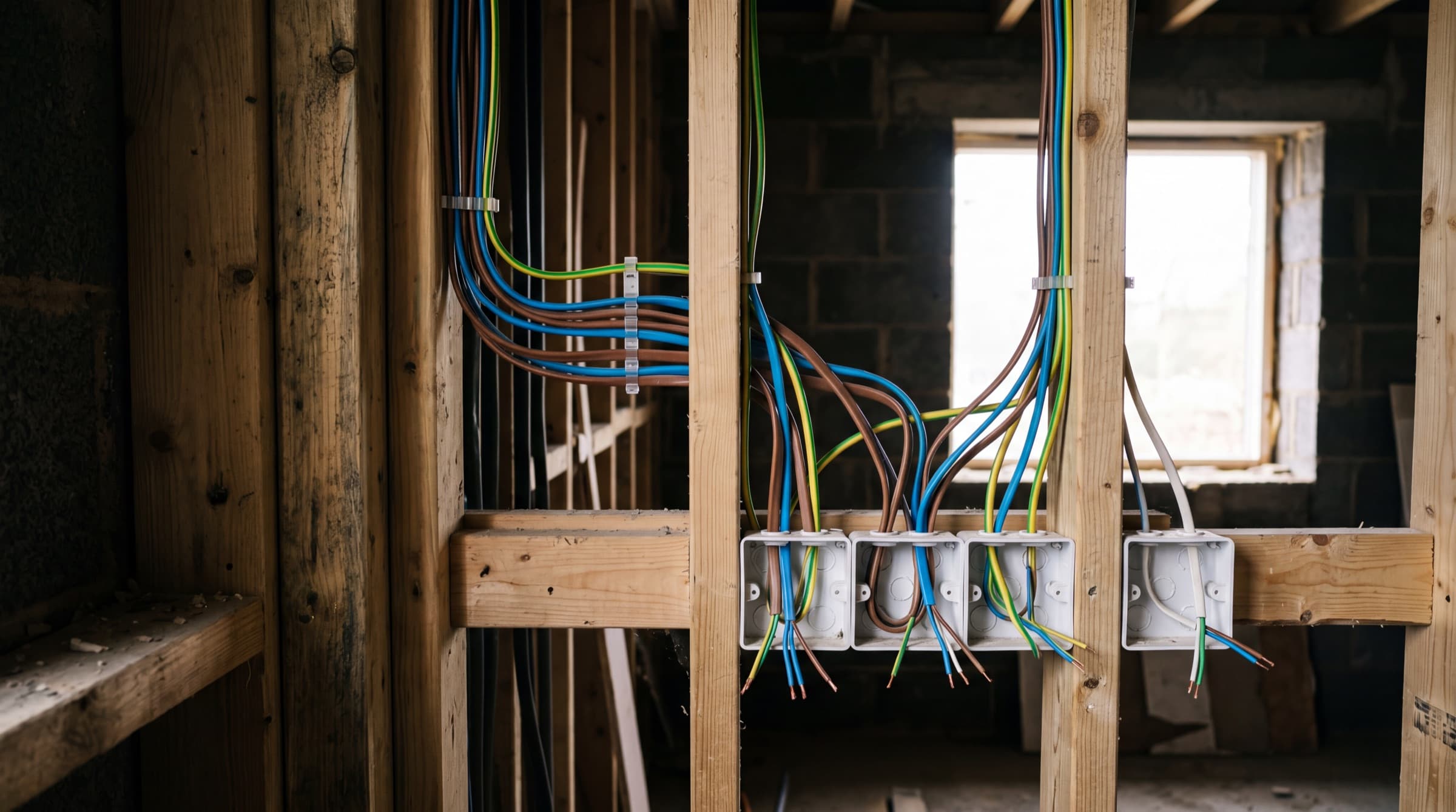
First Fix to Final Cert, One Point of Contact
You are not dealing with layers of subcontractors, and there is nobody to point at when something goes wrong. One crew handles every stage: first fix, second fix, testing and Safe Electric certification. One number to call throughout, and certificates filed as each unit completes rather than assembled at handover.
Developers & Main Contractors
Have you done it at our scale?
That is the only question that matters at tender, so here is the answer with a delivered job attached.
90 units delivered, certified unit by unit
Our largest completed package is a 90-unit residential development in Dublin, covering full first fix, second fix, distribution boards, testing and a Safe Electric certificate on every single unit. Completed 2026. That is the capacity question answered with a delivered job rather than an adjective.
One crew across the programme, not a rotating sub
A crew of 10 means we mobilise across phases without dropping pace and without handing your site to whoever happens to be free that week. One point of contact from first fix to final cert, with no layers of subcontractors and nobody to point at when a snag appears.
Certification that closes out cleanly
Every unit gets its own certificate and test results, filed as it completes rather than assembled in a rush at handover. Your buyers' solicitors get what they ask for first time, and sales close without electrical paperwork holding them up.
For coordinated packages across a full programme, see large-scale residential. For offices, retail and fit-outs, see commercial.
The Package
What’s Included
Full first-fix and second-fix electrical installation
Distribution board supply, installation and configuration
Circuit design and load calculations for the actual spec
EV charging provision, required in new dwellings since 1 Nov 2022
Smoke, heat and CO alarm systems, interlinked
Data and network cabling where specified at design stage
Coordination with the build programme and other trades
Testing and Safe Electric certification on every unit
New builds are quoted from drawings rather than priced from a table, because on a new build the spec is the price. Sockets per room, light points, data outlets and appliance circuits move the figure far more than floor area does. Send drawings or a spec and you get a fixed price back within 48 hours, itemised so you can adjust spec knowingly.
Who You’re Dealing With
Why this job is safe with us
We deliver full electrical packages from first fix to final cert, including a 90-unit residential development in Dublin, certified unit by unit. The same crew and the same standard run a one-off house.
Safe Electric registered
Registration A6700
Verifiable on the public register
Public liability insurance
Up to €6.5M
Cover in place on every job
Crew size
10 electricians
Trading since 2021
Fixed-price quote
Within 48 hours
WhatsApp replies within the hour, Mon–Fri
Largest completed package
90-unit residential development, Dublin
Full electrical package, first fix to completion · Completed 2026
Questions
New builds: what we get asked
How much does it cost to wire a new house in Ireland?
It is quoted from the drawings rather than estimated from the house type, because on a new build the spec is the price. The number of sockets, light points, switches, data outlets and appliance circuits you specify changes the figure more than square footage does. Two identical houses can differ substantially depending on whether the owner wanted two sockets per bedroom or six. What can be said generally is that a new build costs less per point than rewiring the same house, because there is no strip-out, no chasing into finished walls and no making good afterwards. Send drawings and you get a fixed price back within 48 hours.
How much does it cost to connect electricity to a new build?
The ESB Networks connection is a separate cost, paid directly to ESB Networks rather than to your electrician, and it is quoted per site. What drives it is the distance from your site to the nearest network, whether the connection runs overhead or underground, and the capacity you need. Because it is entirely site-specific it cannot be estimated from a house type. It is also the single most common thing self-builders forget to budget for. People price the wiring carefully and get caught by the connection. Apply early: it carries a lead time, and the house cannot be energised without it.
When should I bring an electrician onto a self build?
At design stage, before the foundations go in. On a drawing, moving the board, adding a data run to the home office or putting an EV way in costs nothing. Once the blocks are up and first-fix plumbing has taken the obvious routes, the same changes cost real money and sometimes are not possible at all. The minimum viable point is before plasterboard, but by then you are working around decisions somebody else already made for you.
What is the difference between first fix and second fix?
First fix is everything that has to happen while the walls are open: cable, back boxes and fixed wiring pulled through studwork and blockwork before the plasterboard goes on. Second fix is what goes on afterwards: sockets, switches, light fittings and the consumer unit, once plastering and decoration are done. We schedule second fix after the painter rather than before, because fittings installed ahead of decoration get damaged, and then everyone argues about who did it.
Does a new house have to have EV charging?
Yes, for anything built since 1 November 2022. The Building Regulations (Part L Amendment) Regulations 2022, S.I. 535 of 2022, require electric vehicle recharging infrastructure in new dwellings, so that a charging point can be added later without tearing anything up. For a single new house with parking within its curtilage, that infrastructure has to be there. It is worth going beyond the minimum at first fix: putting in a proper EV way and cable while the walls are open costs a fraction of retrofitting it in three years' time.
Do you work with self-builders, or only developers?
Both, and they are genuinely different jobs. A self-builder is spending their own money, makes every spec decision personally, usually for the first and only time, and wants to talk options through rather than be handed a schedule. A developer needs a crew that hits a programme across dozens of units without supervision. We do both: our largest completed package is a 90-unit development in Dublin, and we also wire one-off houses for people building their own home. The crew and the standard are identical; the conversation is not.
Can you work to our build programme?
Yes, and it is what developers ask about most. First fix, second fix and testing get mapped around your schedule so electrical never becomes the trade holding up plasterboard or handover. A crew of 10 means we scale across phases rather than stretching one team thin, which is the usual reason an electrical contractor slips on a multi-unit site. We would rather tell you at quote stage that a date is tight than agree to it and miss it.
Do you provide certificates for every unit?
Every unit, every time: full completion certificates, test results and as-built documentation as standard. On a development they are filed as each unit completes rather than assembled at the end, which matters because a buyer's solicitor asking for certification mid-sale is not the moment to discover the paperwork is behind. ESB Networks also require certification before energising a new supply, so it is on the critical path either way.
What standard do you work to?
Every installation is completed to IS 10101, the national wiring rules, and certified under Safe Electric registration A6700, verifiable on the public register rather than taken on trust. We carry public liability insurance up to €6.5M. New dwellings also fall under the NZEB requirements in Part L of the Building Regulations, which affect the renewables and heat-pump load the installation has to be designed around, so circuit design and load calculations follow the actual heating and hot-water strategy rather than a generic template.
How quickly can you quote a new build?
Send drawings or a spec and you get a fixed-price quote within 48 hours. For larger developments we arrange a site visit before quoting, because programme and access affect the price as much as the electrical scope does. The quote is itemised so you can see what each element costs and adjust spec knowingly, rather than receiving a single number with no way to interrogate it.
Keep Reading
Related guides and services
From a Single Rewire to Full Developments: Send Us the Details.
Send us your plans or a quick description. We return a fixed-price quote within 48 hours, no obligation, no sales calls.