Built Before 1961
Rewiring a Pre-1960s House: It Fails Invisibly, Not Obviously.
Everything works. The sockets work, the lights work, nothing trips. And the insulation around the conductors has been hardening for sixty years where you cannot see it. That is not a scare story. It is the specific reason this era gets tested rather than guessed at.
230,613
Pre-1961 homes
Across the 13 counties we cover
22.4%
Of all housing stock
More than one home in five
57%
Of them are in Dublin
131,687 homes
CSO Census table FY033A, permanent private dwellings by period of construction. Pulled 2026-08-05. Percentages are of stated stock, meaning dwellings whose build period was recorded.
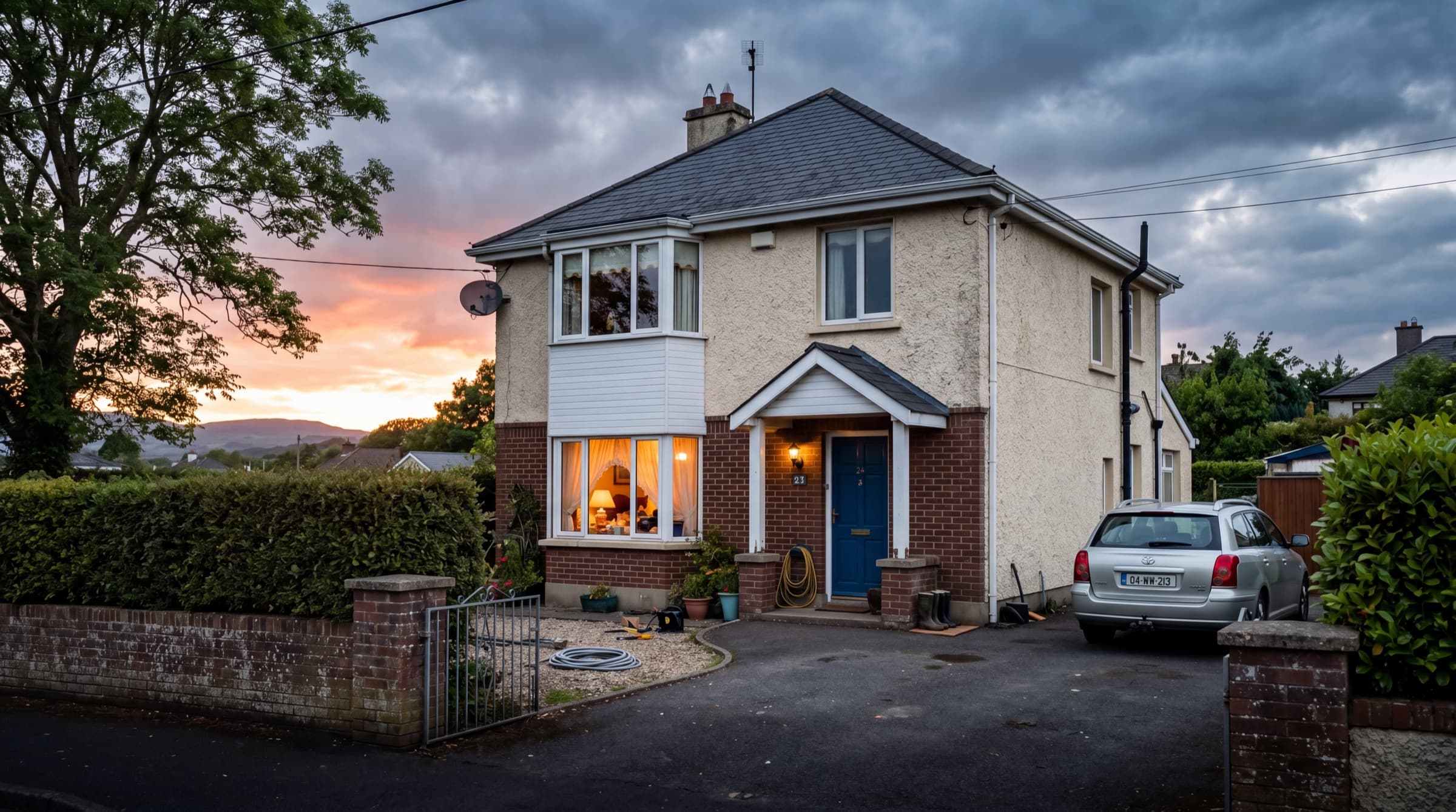
Suspended timber floors are the best thing about rewiring this era. A cable route that needs no wall opened.
Behind The Plaster
Four things we find in this era, none of which announce themselves
Every one of these is normal for the period rather than evidence that anyone did anything wrong. They were correct practice when the house was built. What has changed is what gets connected to them since.
Insulation that has aged from the inside out
The wiring in houses of this age predates PVC. What went in was rubber-insulated cable, often in a lead or braided sheath, and rubber has a working life rather than an indefinite one. It hardens, loses flexibility and eventually cracks. All of that happens from the inside, around the conductor, where nothing is visible. Appearance will not tell you. What tells you is that the insulation crumbles the moment a cable is disturbed, so a straightforward job like adding a socket can turn into a much bigger conversation.
Lighting circuits with no earth
Two-core wiring to switches and light points is common in this era, meaning there is no protective conductor at the fitting. That was normal practice when the house was built and it caused no problem with the metal-free fittings of the day. It becomes a live issue the moment somebody fits a metal light fitting or a metal switch plate to a point that has no earth to connect it to. That happens constantly during ordinary redecoration, by people who have no reason to know.
Main earthing and bonding that predates the current standard
Undersized main earth conductors, and bonding to the incoming water and gas services that is either undersized or absent entirely. This is the least glamorous item on the list and one of the most important, because earthing and bonding are what make every other protective device work as intended. It is also the thing most likely to turn a simple board change into a larger job, and that is a cost worth knowing about before you get a quote rather than after.
Decades of undocumented additions
Sixty years is a long time for a house to accumulate work. An immersion added in one decade, a shower in another, an extension wired by somebody's brother-in-law, a garage supply run in whatever was in the van. Individually these are often fine. Collectively they mean nobody, including the current owner, knows what is behind the walls, and there is rarely any documentation. That uncertainty is itself a finding.
The test that settles it is insulation resistance. It measures whether the insulation around the conductors is still doing its job, circuit by circuit, and it is the single most useful measurement on a house of this age. It either shows the cable is holding up or it shows it is not. There is no interpretation required. See testing and certification for the full test list and what the 1–4 report coding means.
Where This Stock Is
Dublin holds 57% of it, and the commuter belt holds almost none
Worth noticing the inversion at the bottom of this table. Kildare and Meath have the lowest share of pre-1961 stock in the whole coverage area, and that is not because their old houses disappeared. It is because those two counties built so much since that the older stock is a small fraction of a much larger total. The same counties appear at the top of the table for modern housing.
| County | Pre-1961 homes | Share of stock |
|---|---|---|
| Dublin | 131,687 | 26.1% |
| Offaly | 6,847 | 24.3% |
| Kilkenny | 8,631 | 23.9% |
| Waterford | 10,787 | 23.2% |
| Carlow | 4,769 | 22.1% |
| Westmeath | 7,024 | 21.2% |
| Wicklow | 11,229 | 21.1% |
| Louth | 10,098 | 21% |
| Wexford | 11,789 | 20.4% |
| Longford | 3,133 | 20.1% |
| Laois | 5,808 | 19% |
| Meath | 9,872 | 13.9% |
| Kildare | 8,939 | 11% |
| All 13 counties | 230,613 | 22.4% |
What Makes This Era Different
The electrical work is not the hard part. The building is
This is the real difference between rewiring a 1950s house and a 2004 semi. The circuits, the board and the standard are the same national rules either way. What changes completely is how you get a cable from A to B, and what it costs to put the building back afterwards.
| Feature | What it means for the job |
|---|---|
| Solid walls, no cavity | There is nowhere to drop a cable. Every run either gets chased into solid masonry, boxed in, or routed around through floors and the attic. Chasing solid walls is slower than chasing a modern block-and-plasterboard wall and the making good afterwards is a plastering job rather than a filler-and-sand job. |
| Lath and plaster ceilings | Fragile, and expensive to repair properly if they are damaged. An electrician working above them has to be far more careful than in a house with plasterboard, and where a ceiling is original and worth keeping, that caution has a time cost that belongs in the quote honestly rather than as a surprise. |
| Suspended timber floors | The one that works in your favour. A suspended floor is an excellent cable route and it means a large share of the rewire can happen without touching a wall at all. Where a house has these, the making-good bill drops substantially, and that is a real reason two houses of identical age can be quoted very differently. |
| Protected structures and conservation areas | If the house is on the local authority's Record of Protected Structures, or sits inside an Architectural Conservation Area, works that affect its character can need permission, including things like surface conduit or altering original fabric. It is worth checking with the local authority before design rather than mid-job. Tell us at quote stage if this applies; it changes how we route. |
Check the protected-structure question early. Your local authority keeps the Record of Protected Structures and can tell you whether a property is on it, or whether it falls inside an Architectural Conservation Area. It is a phone call, and it is far better made before a design than during a job.
Cost
Expect the upper half of the range, and here is exactly why
We publish real ranges rather than hiding behind “contact us for a quote”. They are a guide, not a quote. A full rewire on a three-bed runs €7,000 to €12,000, and on this era you should plan for the upper half of that band.
The reason has almost nothing to do with the electrical work. It is making good. Chasing a cable into a solid masonry wall and putting that wall back to a decorated finish is plastering, drying time and paint. That is real trade work with a real cost, and far more of it than in a house with cavity walls and plasterboard. That single variable is the biggest reason two houses of the same age and size get quoted very differently.
So the routing survey matters more here than anywhere else. A house with suspended timber floors and a usable attic can often be rewired with a fraction of the wall-opening, and the price reflects that. Part of what you are paying for at the quote stage is somebody working out which walls have to be touched at all.
Ask every quote which of these three it is
Chased and made good ready for decoration · chased and left for your own plasterer · surfaced in trunking with no chasing at all. On this era that one answer can move the total by thousands, and a quote that does not state it is not comparable with one that does. Ours says so explicitly.
The figures above are indicative ranges for guidance only. They are not a quote and not an offer. Rewiring varies enormously with floor construction, wall type, circuit count, access and the condition of what is already behind the plaster. None of that can be judged from a photograph or a phone call. Jamie gives you an accurate fixed price in writing after the installation has been tested.
The full cost guide
Cost by property type, the six things that move the price, and what a partial rewire saves against a full one.
And we’re set up to act on it. J Cowman Electrical Contractors has been Safe Electric registered since 2021 under registration A6700, carries public liability cover up to €6.5M, and runs a 10-strong crew across Wexford, Dublin and the rest of Leinster. Every job is certified to IS 10101 and the completion certificate is handed over on the day the work finishes, whether that job is a board change or a full rewire.
FAQ
Pre-1960s Houses: Common Questions
My house is from the 1950s and everything works fine. Does it really need rewiring?
Maybe not, and we would rather test than assume. "Everything works" and "the installation is sound" are different statements, because the failure mode in this era is not that things stop working. It is that insulation resistance drops while sockets and lights carry on behaving normally. The test that answers this is insulation resistance, measured circuit by circuit, and it either shows the cable is holding up or it shows it is not. Plenty of houses of this age have had a partial rewire at some point and are in better shape than their age suggests. The only way to know which you have is to measure it, and that is a couple of hours' work rather than a guess.
What goes wrong with old rubber cable?
The rubber loses its plasticisers over decades, hardens, and becomes brittle. Because the deterioration happens around the conductor, inside the sheath, you cannot see it by looking at the visible ends. What tends to expose it is disturbance: someone lifts a floorboard, pulls a cable to add a socket, and the insulation cracks off in flakes where it was bent. So an apparently small job in a house of this age can turn into a much bigger conversation on the day. We would rather test the whole installation first and give you a real picture than quote a socket and discover the rest halfway through.
Can I do it in stages instead of all at once?
Often yes, and on this era it is frequently the sensible approach. A partial rewire tackles the worst circuits, typically the ones that fail on insulation resistance plus anything feeding a bathroom or a kitchen, and leaves sound circuits alone. You can usually stay in the house for that, working room by room, with power available everywhere else. The caveat worth stating plainly is that a partial rewire on badly degraded cable is deferral rather than a solution, and the test results tell us which situation you are in. Where the whole installation is failing, doing it in stages costs more in total than doing it once.
How much does it cost to rewire a house of this age?
A three-bed semi runs roughly €7,000 to €12,000, and on this era you should expect to sit in the upper half of that band rather than the lower. The reason is not the electrical work. It is making good. Solid walls mean chasing and replastering rather than filling, and that is real trade work with a real cost. Where a house has suspended timber floors and a usable attic, a lot of the cable can be routed without opening walls at all and the figure drops accordingly. Those figures are indicative ranges for guidance, not a quote; the accurate number comes after we have tested and walked the house.
Do I have to move out?
For a full rewire on this era, usually yes, or at least into one part of the house while the other is done. Floors come up, sections of ceiling come down, and power is off for extended periods. A five-to-eight day job for a team of two is typical on a three-bed, though a larger period house with difficult access takes longer. For a partial rewire you can normally stay put. It is worth asking us to sequence the work around whichever rooms matter most to you. That is usually possible and it costs nothing to plan.
What if the house is a protected structure?
Tell us at quote stage, because it changes the design rather than the price alone. If the property is on the local authority's Record of Protected Structures or sits within an Architectural Conservation Area, works affecting its character may require permission, and that can include visible interventions like surface-mounted conduit or the alteration of original fabric. In practice it usually means routing through floors and existing voids wherever possible and avoiding chasing original plasterwork. It is entirely workable. It just needs deciding before anyone starts rather than during.
The lights have no earth. Is that dangerous?
It depends entirely on what is fitted at the point. Two-core wiring to light points was ordinary practice in this era and it caused no problem with the all-insulated fittings of the day. The risk arrives when somebody fits a metal light fitting or a metal switch plate to a point with no protective conductor to connect it to, which happens routinely during redecoration by people who have no way of knowing. If your fittings are plastic or all-insulated, the situation is stable. If you are planning to change light fittings, it is worth establishing what is behind them first.
Will a new fuse board sort it?
It will improve your protection considerably, and it will not repair the cable. A modern board with per-circuit RCBOs means a fault isolates to one room and earth-leakage protection exists where it previously did not. Both are real gains. But if the insulation on the circuits behind it is deteriorating, that is still true afterwards. What often happens is that a new board makes an existing problem visible, because circuits that were quietly leaking start tripping the moment something is watching for it. That is useful information, not a malfunction. Our fuse board page covers this distinction in full.
How long does the work take?
A three-bed of this era is typically five to eight working days for a team of two, plus making good. A larger period property, a house with difficult access, or one where original ceilings have to be protected takes longer, and we would rather tell you a realistic figure at quote stage than a hopeful one. Testing and certification happen as we go rather than at the end, so the Safe Electric Completion Certificate is handed over on the day we finish rather than posted at some point afterwards.
Do I need any of this if I am selling?
No Irish law requires an electrical certificate in order to sell a property. What a buyer's solicitor will ask for is the Completion Certificate covering any electrical work that was carried out. If a previous owner had a rewire or a board change done and the paperwork is missing, that is what stalls a sale. On a house of this age, a Periodic Inspection Report is also a straightforward way to answer a buyer's obvious question before they ask it, which is a reasonable commercial reason to have one even though nothing obliges you to.
Related
Where to go next
Not sure whether yours needs doing?
Tell us the year it was built, whether the floors are timber or concrete, and send a photo of the board. That is usually enough for a straight answer on whether it is worth testing.
Written and checked by
Jamie Cowman, Registered Electrical Contractor
Jamie runs J Cowman Electrical Contractors and holds Safe Electric registration A6700, which is what allows a Completion Certificate to be issued on this kind of work. Everything on this page reflects how the job is actually priced and sequenced on site, not a generic specification.
From a Single Rewire to Full Developments: Send Us the Details.
Send us your plans or a quick description. We return a fixed-price quote within 48 hours, no obligation, no sales calls.