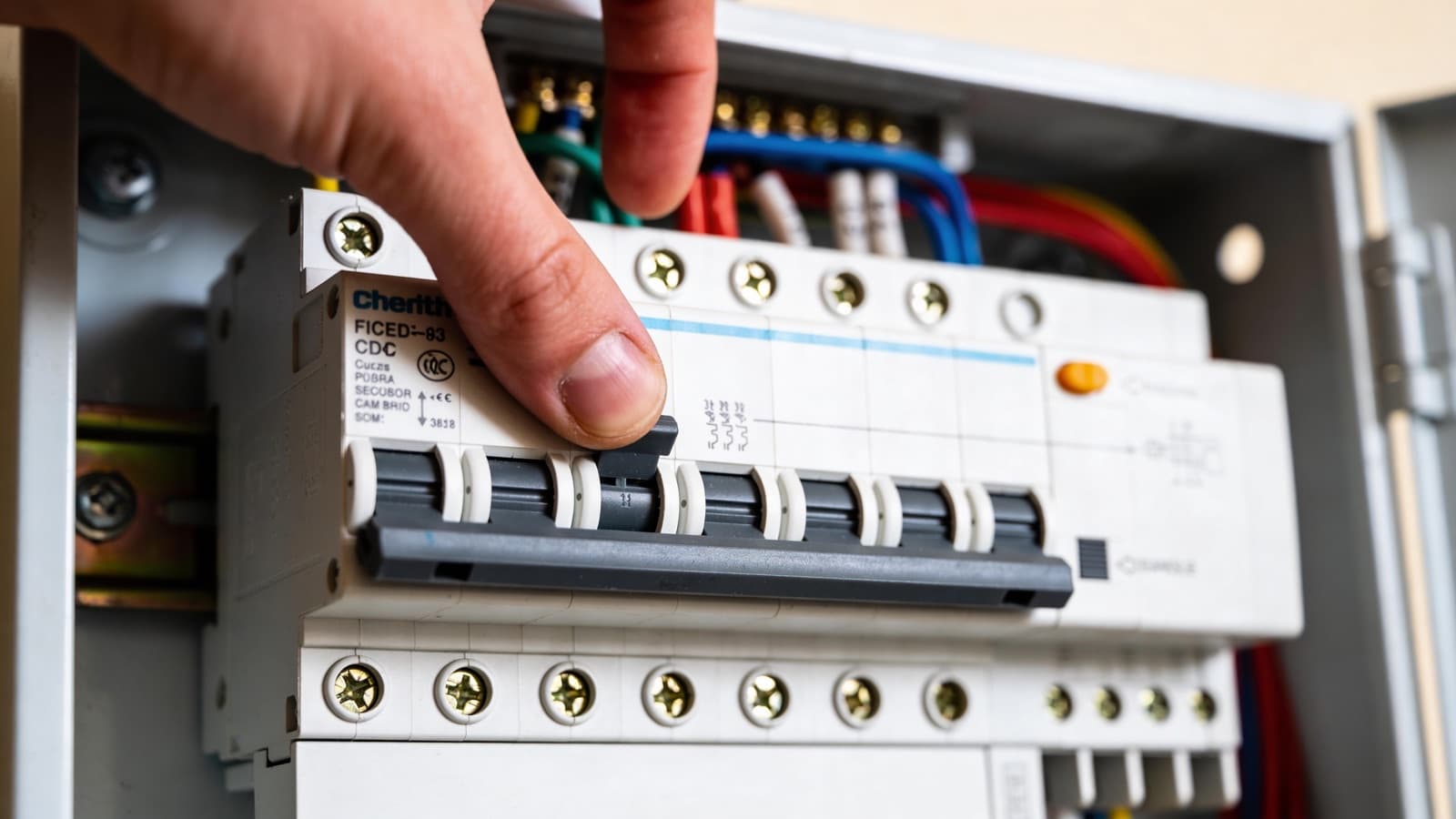
A tripping fuse box is annoying, but it's also your safety system working exactly as designed. The trip switch (an RCD or MCB) cuts the power the instant it senses something wrong, which is far better than the alternative. The trick is working out what it's reacting to. Here's how to do that safely.
First: Find the Circuit That's Tripping
Open your consumer unit and look at the switches. The one flipped to "off" (or sitting halfway) is the circuit with the problem. If it's the main RCD (the bigger switch, usually with a "test" button) it protects several circuits at once, so the fault could be on any of them. Here's the safe way to narrow it down:
- Switch every breaker to off
- Reset the main RCD so it stays up
- Switch each circuit breaker back on one at a time
- When the RCD trips again, the last circuit you switched on is the culprit
Common Cause 1: A Faulty Appliance
The most frequent reason by far. A failing kettle, immersion, washing machine (even a phone charger with a damaged cable) can leak current and trip the circuit. Once you've found the affected circuit, unplug everything on it, reset the breaker, then plug items back in one at a time. The appliance that trips it again is the one to repair or retire.
Common Cause 2: An Overloaded Circuit
Too many high-draw appliances on one circuit (a kettle, toaster and microwave on the same kitchen ring) can pull more current than the breaker allows. If the trip happens at predictable busy moments, overload is the likely answer. Spreading the load helps, but if it keeps happening the circuit may need attention.
Common Cause 3: Moisture
If your electrics trip when it rains, or after a shower, water is getting somewhere it shouldn't, an outdoor socket, a garden light, a bathroom extractor, or a leak reaching a cable. Take this one seriously: water and electricity together is precisely the hazard the RCD exists to catch.
Common Cause 4: A Damaged Cable
A nail or screw through a wall, a cable nicked during DIY, or old wiring breaking down can all cause a persistent trip with nothing plugged in. If a circuit trips with every appliance unplugged, the fault is in the fixed wiring itself, and that needs an electrician.
The Trip Won't Reset At All
If the switch won't stay up no matter what you unplug, stop resetting it. A breaker that refuses to hold is telling you there's a live fault on the circuit. Forcing it achieves nothing, and the repeated arcing isn't doing the board any good. Leave that circuit off and get it looked at.
What Not to Do
- Don't keep flipping a breaker that won't hold. You're not fixing it, you're stressing it
- Don't tape or wedge a switch into the on position. Ever.
- Don't ignore a board that's warm, scorched, or smells of burning: switch off the main and call an electrician
- Don't open up sockets or the board yourself unless you're qualified
When to Call an Electrician
Call us if the circuit trips with everything unplugged, the breaker won't reset, you smell burning, the board is warm, or the tripping is getting more frequent. These point to a fault in the fixed wiring or the board itself, not a dodgy appliance, and that's our job, not a DIY one. If it's urgent and the power is out, don't sit in the dark second-guessing it.
If your house was built between 1991 and 2010, read do you need a rewire or just a new fuse board? first. Houses of that age almost never need a full rewire, and the job is usually a board upgrade.